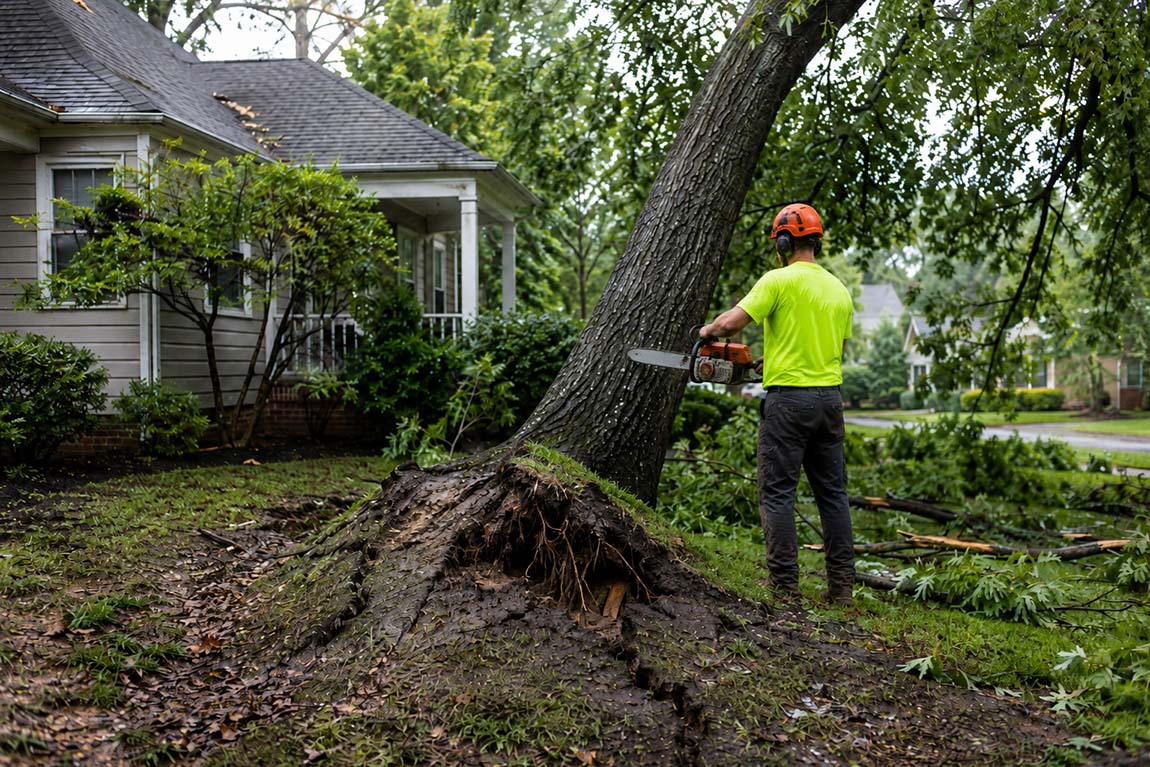
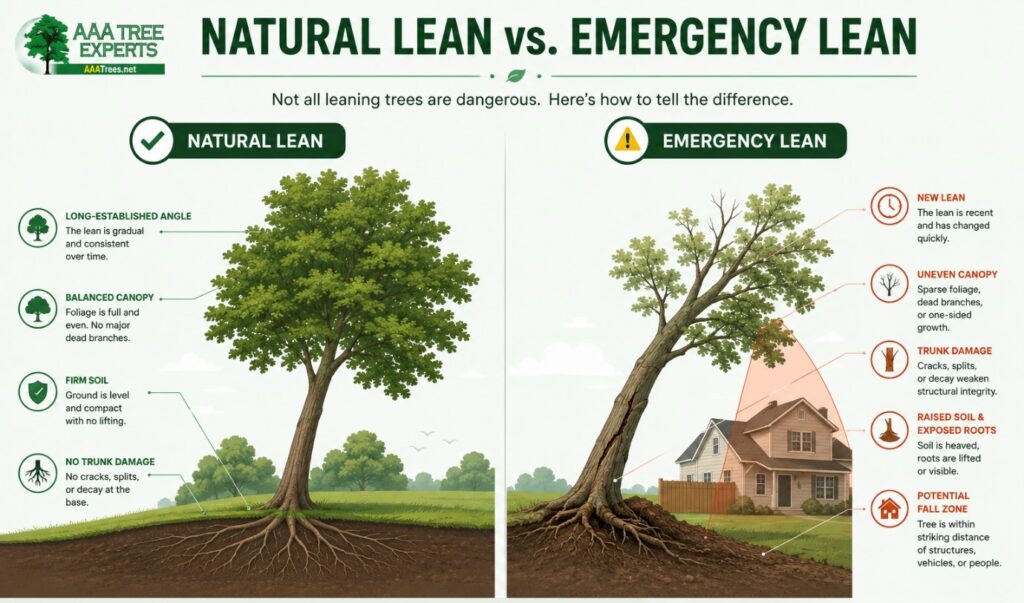
A leaning tree is not automatically dangerous. Some trees grow at an angle because of terrain, competition for sunlight or conditions that existed when they were young. The more important questions are whether the lean is new, whether it is increasing and whether the tree shows signs of structural failure.
After high winds or prolonged rain, a noticeable change deserves prompt attention. Homeowners cannot determine the full condition of a tree from appearance alone, but the following warning signs may indicate a leaning tree emergency.
1. The lean appeared suddenly
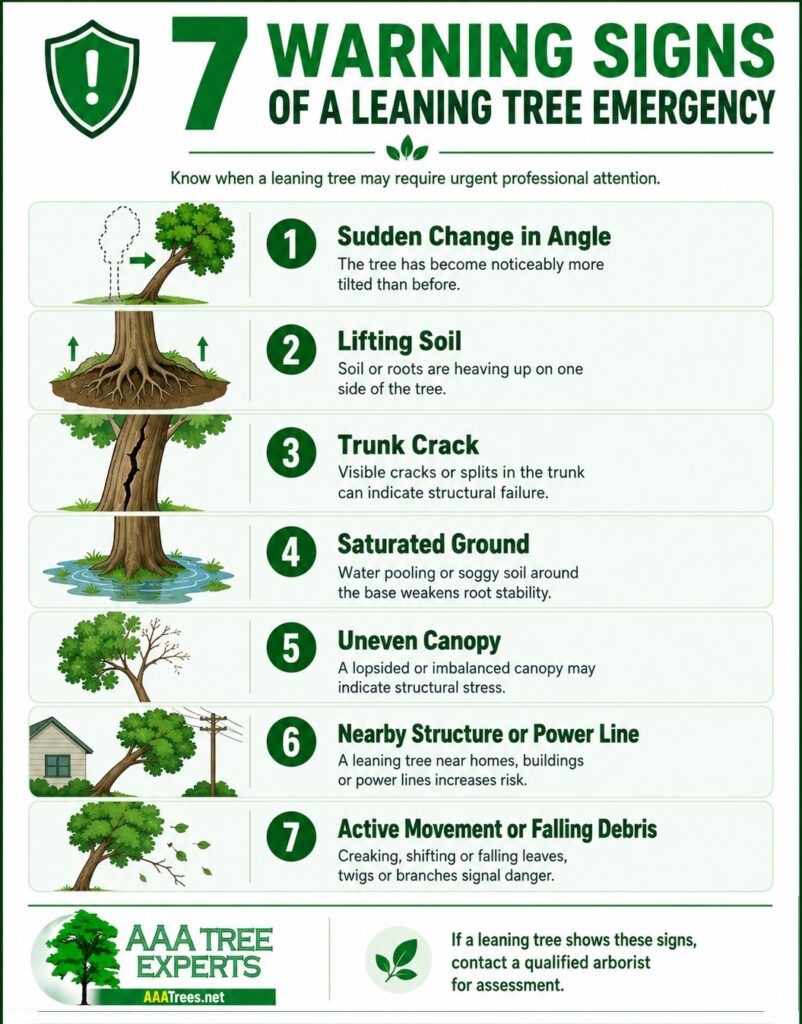
A tree that has held the same angle for many years may have developed supporting roots and corrective growth. A tree that shifts over hours or days presents a different concern.
A sudden lean following thunderstorms, strong winds, saturated soil or nearby excavation should be evaluated promptly. Arrange a tree risk assessment in Charlotte rather than approaching the tree to investigate it closely.
2. Soil is lifting or cracking around the roots
Look from a safe distance for newly raised soil, widening gaps around the trunk or roots pulling upward on one side. These changes may indicate movement in the root plate—the soil-and-root system that anchors the tree.
Root movement is especially concerning when the tree has a large canopy, a worsening lean or visible damage near the base.
3. The trunk has a fresh crack or split
Cracks may appear near the base, along the trunk or where two large stems meet. Fresh exposed wood, a widening opening or separation between major stems can indicate significant structural stress.
Do not touch the crack, insert tools or strike the trunk to test it. These actions cannot establish whether the tree is stable and may place you directly within its fall zone.
4. The surrounding ground is saturated
Extended rain can soften the soil around a tree’s roots. Wind acting on the canopy may then place additional strain on a weakened, decayed or restricted root system.
Charlotte homeowners should be particularly cautious when a tree begins leaning after a storm while the ground remains waterlogged. Saturated soil alone does not mean a tree will fall, but it becomes more serious when combined with lifted roots, trunk damage or recent movement.
5. The canopy is severely unbalanced
A tree may shift after losing a major limb or after improper pruning leaves most of its weight on one side. The remaining canopy can place uneven pressure on the trunk and roots.
Do not attempt to rebalance the tree by cutting large branches yourself. Removing weight can cause sudden movement or release storm-damaged limbs. When the condition presents an immediate threat, professional emergency tree removal may be necessary.
6. The tree is leaning toward a high-risk target
Tree risk depends on both the likelihood of failure and what the tree could strike. A tree leaning over a home, vehicle, sidewalk, playground, road or utility line requires more urgent attention than one leaning toward an unused open area.
Keep people, pets and vehicles outside the potential fall zone. When power lines are involved, do not approach the tree or attempt any cutting. Contact the utility provider and an experienced emergency tree service in Charlotte, NC.
7. The tree is moving, creaking or dropping debris
Visible movement during calm conditions, repeated cracking sounds, falling bark, dropping limbs or shifting soil may indicate active failure. Leave the area rather than continuing to observe from close range.
Do not stand beneath the canopy to locate a sound. Move to a location outside the tree’s likely path and request emergency assistance.
What should Charlotte homeowners do next?
Establish a safe perimeter based on the tree’s height and direction of lean. Keep children, pets, vehicles and neighbors away. Photograph the tree only from a safe location; recent images may help an arborist understand what changed.
Do not use ropes, ladders, chainsaws or vehicles to pull the tree upright. A compromised tree can move without warning, and broken branches may remain suspended overhead.
For public-tree emergencies, the City of Charlotte directs residents to call 911 for active tree failure, a tree blocking a road or a right-of-way tree that has fallen onto private property. Non-emergency concerns involving public right-of-way trees can be reported through 311 or CLT+.
Can a leaning tree be saved?
Sometimes. The recommendation depends on the tree’s species, size, root condition, trunk integrity, degree of movement, soil stability and proximity to people or structures.
Professional pruning, monitoring or other corrective care may be appropriate in some cases. Major root failure, severe trunk separation or an unacceptable risk to nearby targets may require tree removal in Charlotte, NC. Only an on-site assessment can determine the safer course.
Request an emergency tree assessment
A tree does not have to be on the ground to create an urgent hazard. If a tree on your property has developed a sudden lean, lifted roots, trunk cracking or active movement, keep your distance and contact AAA Tree Experts.
Our team provides professional tree assessments and 24/7 emergency response throughout Charlotte and nearby communities. Contact AAA Tree Experts for a prompt evaluation before a worsening condition places your home, family or property at greater risk.