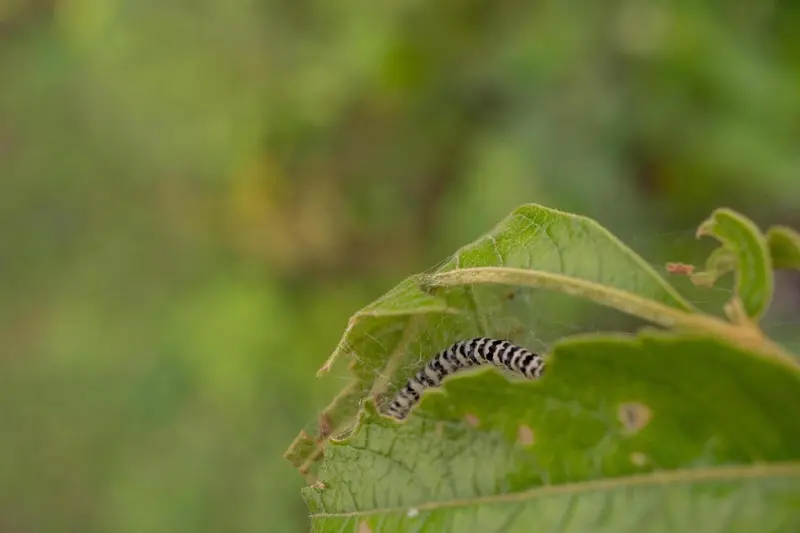
Every spring, a small green inchworm drops from Charlotte’s oaks on a thread of silk, lands in someone’s hair, and ruins an otherwise pleasant walk. That worm is a fall cankerworm, and it has thrived here for decades. The reason it keeps coming back has a lot to do with what Charlotte planted a century ago. The reason it can be stopped comes down to a strip of sticky material wrapped around a trunk at exactly the right time of year.
Getting that timing right is where most homeowners go wrong.
Why Charlotte trees are such an easy target
Charlotte built its canopy on willow oaks, and willow oaks happen to be the cankerworm’s favorite meal. The city’s dense concentration of old hardwoods has let the population climb steadily for roughly 30 years, which is why you see those wrapped trunks all over town each winter and barely anywhere else in the state.
The pest does real damage. A heavy infestation strips a mature tree’s leaves in spring, forcing it to burn stored energy growing a second set. Repeat that for a few seasons and the tree weakens, sheds branches, and turns into an easy mark for disease. The mess is the part neighbors notice first: silk threads draped across driveways, worms dropping onto cars, and a steady rain of frass under the canopy. Evergreens like pines and magnolias get a pass. Hardwoods, especially oaks and maples, take the hit.
That is why cankerworm tree banding in Charlotte sits closer to routine yard maintenance than emergency care.
When to band: the short answer
Wait until the leaves fall.
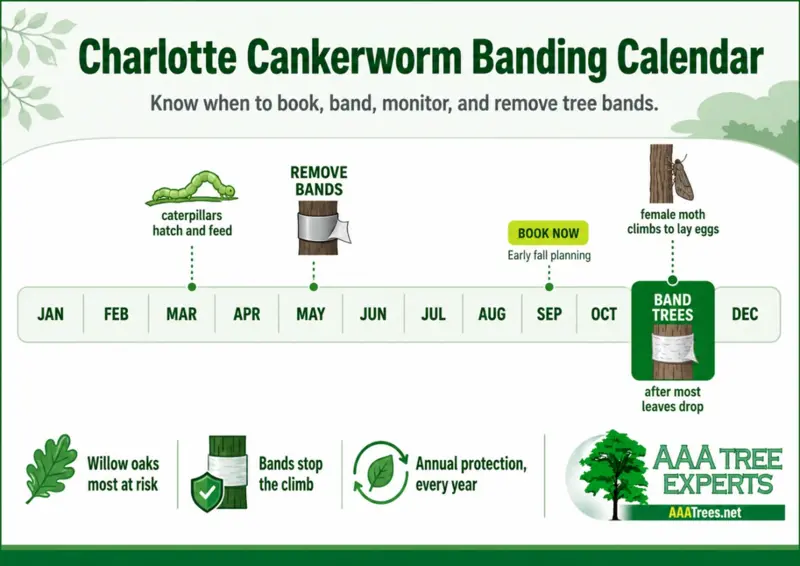
The wingless female moth cannot fly. To reach the canopy and lay her eggs, she has to climb the trunk on foot, and a band coated in sticky barrier stops her cold. Stop her there and the eggs never get laid, which means no defoliating brood the following spring. The catch is that fallen leaves pile onto the band and hand her a bridge to walk across. North Carolina State Extension advises waiting until most leaves have dropped, which across much of the state lands in mid to late November.
Band too early and you trap leaves instead of moths. Band too late and the females are already up in the branches laying eggs. The window is narrow, and it shifts a little each year depending on when the trees actually let go of their leaves. That is the part a calendar reminder cannot solve for you.
When to take the bands down
Bands are not a set-and-forget job. Leave them up through spring, into early May, because a second species, the spring cankerworm, climbs later and feeds on the same canopy. Pull the bands in December and you have done half the work.
Through the season, each band needs a look every few weeks. Leaves, debris, and dead moths collect on the surface and build their own bridge, so the sticky layer occasionally needs a fresh coat. Once the spring climbing stops, the bands come off.
Then next November, it starts again. Cankerworm control is an annual habit, not a one-time fix, and skipping a single year is usually enough to let the population rebuild.
Should you band the trees yourself?
You can. Tree banding is low-tech at its core: insulation, wrap, and a sticky barrier such as Tanglefoot. Plenty of Charlotte neighborhoods band together, and the city even runs a matching grant program, with eligible neighborhoods able to apply for up to $3,000 toward the work. The civic effort exists because the problem is genuinely citywide, not a nuisance on one or two streets.
The trouble lives in the details. Tanglefoot is famously messy and stubborn to clean off bark, clothes, and skin. A willow oak taller than a two-story house is not a stepladder job. And the timing window is tight enough that a busy autumn slips past before the bands ever go up. Get any one of those wrong and the whole effort protects nothing.
That is where a certified arborist in Charlotte earns the call. A trained crew bands at the correct height, packs the gaps in furrowed bark where moths sneak underneath, and reads the season rather than the calendar. Pair banding with ongoing tree health care and a stressed tree gets a real shot at bouncing back.
Protect your canopy before the leaves drop
Cankerworm season arrives every year, and the trees worth protecting are the ones that took decades to grow. AAA Tree Experts has banded Charlotte’s hardwoods for over 20 years, and a consultation with our arborist costs nothing. Call us at 704-366-1134 or book your tree banding in Charlotte, NC before the leaves drop, and we will help you stand firm and band against the cankerworm.